Showing posts with label QCXMini. Show all posts

Saturday, 7 May 2022

QRP Labs QCX Mini - Part 4: a QRP antenna tuner

Now that the QCX Mini and its power pack have been finished, there was only one part still missing: an antenna tuner to match! (pun intended, HI)

Just like the battery pack, the antenna tuner would need to be small, rugged and portable, and not too expensive. You probably know where this is going, don't you?

Yep, this is going to be another report on building the infamous Chinesium 'Manual Days' antenna tuner kit. In my defense, I bought the kit before I knew anything about antenna tuners, so the low price was enough to convince me that this was the kit to buy...

The parts arrived in a cheap plastic bag, and spent a couple of months on a shelf not only waiting for the QCX Mini and its battery pack to be finished, but also for me to learn CW, which is still a daily struggle! Meanwhile, I did read up on the tuner kit, and realized that looking at low cost alone probably wasn't the best way to select an antenna tuner. First of all, the looks of the kit were less than impressive:

A manual antenna tuner doesn't need to be very complicated though. And well, all the parts seemed to be there:

Well the kit was here anyway, so I decided to just give it a try and build it. Not in the original box of course, that thing is just *** Ugly :(
The schematic did not seem to be too complicated, and I calculated (rather optimistically) that the whole thing should be able to fit in a 100x54x30mm box:

A nice and compact enclosure was ordered, and turned this little project into a bit of a challenge. 


Mistakes were made

There's lots of articles on the Internet on this particular kit, and they nearly all mention the terrible build instructions. The complaints seem to mostly focus on the toroid coils, and it's easy to understand why. This is what I found:

  • The small FT37-43 transformer connections are correct in the schematic diagram. However, on some of the circuit boards the wiring is printed in reverse. Please make sure to check this before mounting this part! The 5-turn winding should connect to the 1N60 diode. My PCB (the V 2.0 version) had correct markings though.
  • The larger T106-2 toroid is shown wired in reverse. The 10-turn section should be at the end. The 1-turn section should connect to the variable capacitors. Failing to do so will result in a tuner that's impossible to reach a match on most of the bands.

 It's probably best to carefully check the PCB and building instructions against the schematic (which is correct). There may be other versions with even more mistakes!


The build

First, drill the holes to fit the switches, BNC connectors and variable capacitors:

In this version an analog meter was added. I like to think that it allows for a more accurate SWR reading, although just using the LED also seems to work fine. It did however add to the challenge; I had to cut the PCB to make everything fit!


Winding the toroid coils

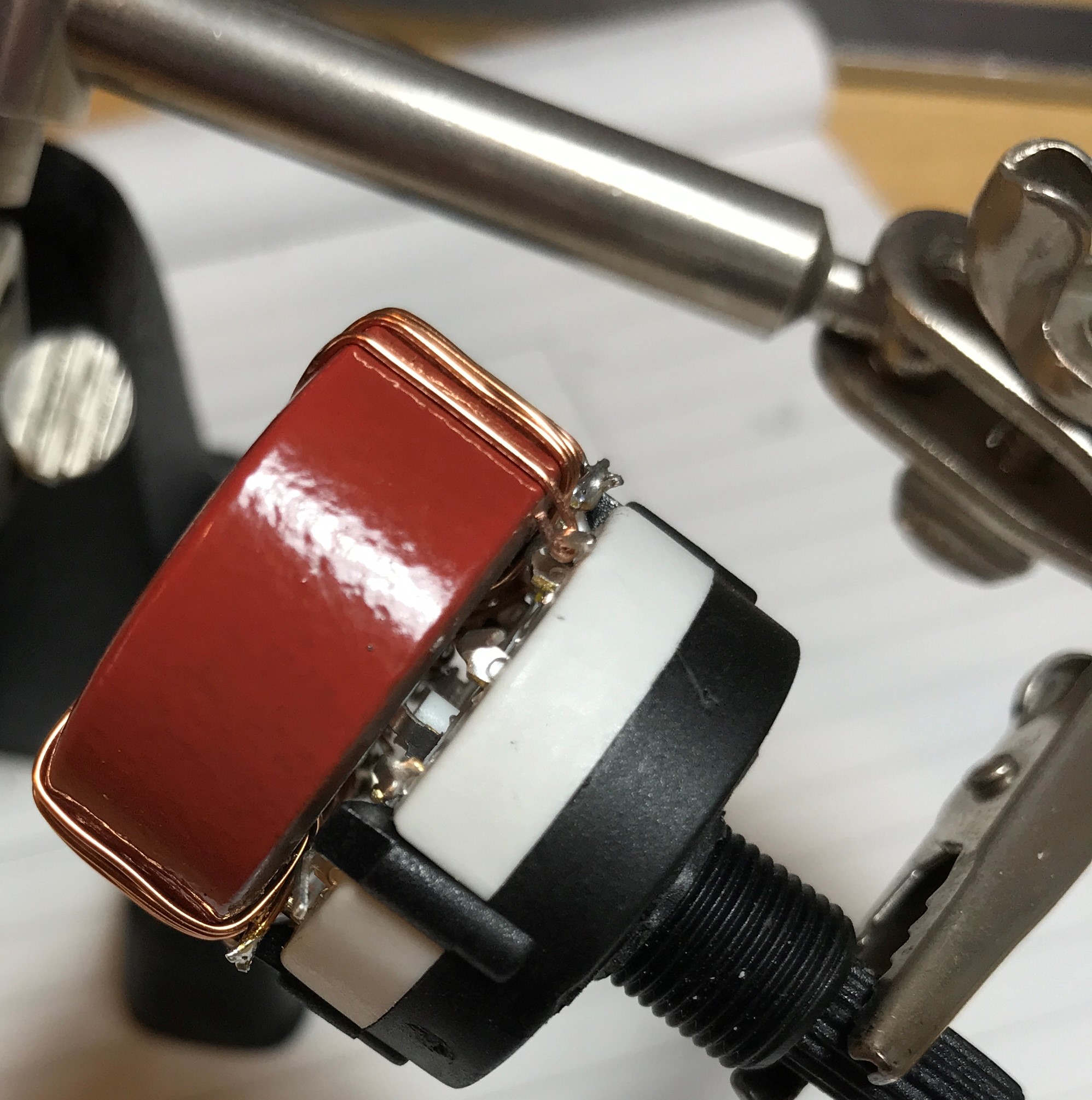
The small FT37-43 coil is quite easy to wind. The larger T106-2 coil is another matter. The original instructions didn't work for me, due to the small size of the enclosure. I decided to go for another approach, which allows me to mount the toroid very close to the rotary switch:

The switch contacts can then be used as hooks to connect the taps:

Here's another closeup:
Putting it all together

Using the winding technique shown above I was able to make everything fit into my enclosure. It was a close call though!

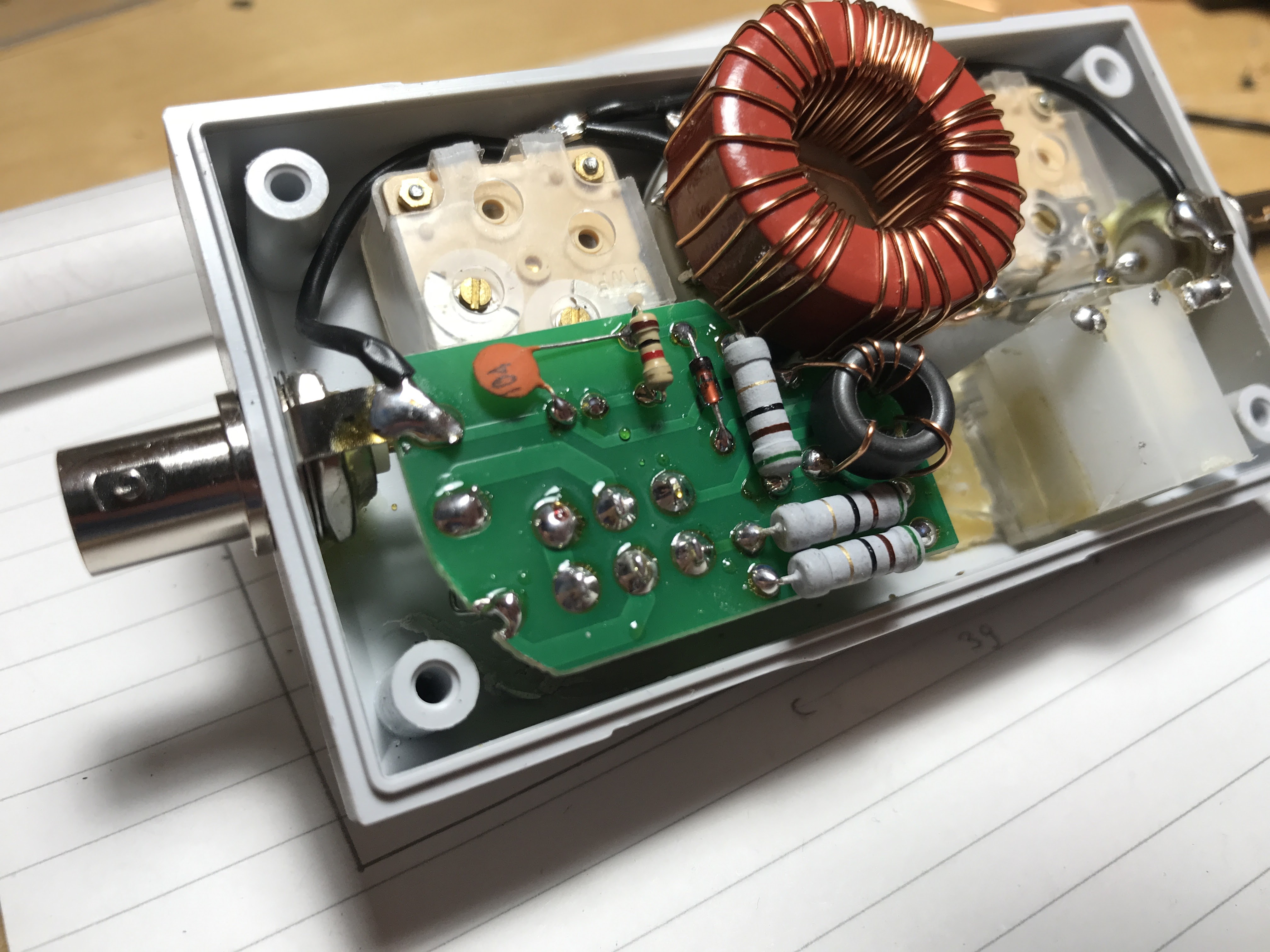

The end result

So here's the finished antenna tuner:

Yes I know, it's still no looker. But much to my surprise, it works perfectly well! I'm now able to match my QCX mini to nearly everything that can be used as an antenna (although to be fair a full size resonant wire antenna like an EFHW always will be a better option).
It's also light, sturdy and just as small as the QCX mini.

Mission accomplished I'd say :)


Information sources I've used:

DigitalShack.org - QRP 1-30Mhz Antenna Tuner

KP4MD - Fixing a Chinese "QRP Manual Days" Antenna Tuner Kit

Monday, 8 February 2021

QRP Labs QCX Mini - Part 3: a portable powerpack

The QCX Mini! An amazingly small and versatile mini CW - only transceiver for amateur radio. Read all about it here:

QRP Labs Kits website

The kit is really nice out of the box, but there's always room for modifications. Some are necessary, some are just nice-to-haves or just plain silly (as always, I'll leave it up to you to categorize this article).

A portable power supply

Having a portable transceiver is nice, but it will not do much good if the battery isn't equally portable. Here's a quick description of my solution to this.

What type of battery to use?

To achieve optimal portability we will need a compact battery pack that is easy to charge and has a good capacity to weight ratio. RC planes and model cars make use of very compact batteries, but these generally require a special charger with balancing connector.

Fortunately battery packs exist with built-in balancing boards. While more expensive, these are much easier to connect and charge. The extra costs are offset by the fact that they can be charged with a normal adapter.

The parts

It's simple really. This is all you need:


I've settled for a 2600mAh Li-Ion battery pack from Ansmann, a German supplier of high quality batteries. I'm sure other suppliers exist, but this one is readily available here in Europe. Why this one? Well, because it includes all this:

  • Balancing logic to properly charge each individual cell
  • Charge controller, to allow charging from a standard Li-ion charge adapter
  • Electronic short-circuit protection, resets automatically after next charge cycle
  • High voltage (overcharge) protection
  • Low voltage (discharge) protection

So, adding a fuse holder, switch and DC socket and some time leads to this:


Perfect! At 100x82x27mm the enclosure is a bit larger than the QCX Mini (but not much) so they can be stacked op top of each other. The battery pack supplies 14.4 Volts and even a bit more when freshly charged,  so if you have a version 1 QCX mini please make sure to apply the regulator mod first!

(Don't know what that is about? Please check this article)

The QCX Mini draws less than 90mA @14.4Volts even with the backlight on, and less than 1A on key down, so 2600mAh will keep the Mini happy for a long time; certainly more than a day of normal use. 

Parts List:

  • Battery pack: Ansmann 4INR19/66 4-cell Li-Ion (Conrad no 2250358)
  • Fuse holder: Conrad no 533769 or equivalent
  • Switch: Conrad no 703486 or equivalent
  • Metal enclosure: EBay 143844704460 (or search for 'Extruded Aluminium Project Box')
  • Charger: 16.8Volt / 1Amp Li-Ion charge adapter (AliExpress, Ebay or local supplier)


Any comments on this article? Need more details? Please drop me a line below!

QRP Labs QCX Mini - Part 2: Adding Cooling

The QCX Mini! An amazingly small and versatile mini CW - only transceiver for amateur radio. Read all about it here:

QRP Labs Kits website

The kit is really nice out of the box, but there's always room for modifications. Some are necessary, some are just nice-to-haves or just plain silly (I'll leave it up to you to categorize this particular mod).

Cooling the RF finals

The QCX Mini is advertised as a 5-Watt transceiver and this goal can definitely be achieved on a 12 Volt power supply, especially if you follow Hans Summer's video tutorial here:

Hans Summers: Tuning up your QCX+

A bit of tweaking yielded just over 5 Watt @12 Volts. However, increasing the power supply voltage to 14.4 Volts (standard output for a LiFePo4 battery pack) then saw an increase to over 7 Watt! The RF power amplifier did start to run a bit hot though. And as usual, that's when my OCD decided to take over. What if there was a way to improve the cooling?

Let's dig in shall we?

The RF power amp is designed around three BS170 MOSFETS, held down by an M3 bolt and washer. First I decided to just add a second (larger) washer on top, and add some heat sink paste to improve heat conduction. Like this:


While this will probably help a bit, it didn't look like a worthwhile improvement. Hmm, I wonder if there are cooling solutions small enough to fit on top of the transistors?
But of course there are!


BGA heat sinks can be as small as 14x14x6mm, almost (but not quite) small enough to fit in the QCX Mini. A couple of the fins will need to be removed or filed down, and it needs a 3mm center hole.
I also reshaped the bottom somewhat to improve thermal contact with the transistors:


That's better! Add some new thermal paste and refit, using the original bolt and a smaller washer:


And yes, it really does fit in the very limited space available under the display board:

Will it make a difference?

This whole exercise was meant only to satisfy my curiosity really. I don't know if it will make a difference in the long run; I don't even know if cooling these transistors is even necessary or effective. But at least I've given them all the care and attention I was able to think up. I will still keep a number of BS170 in stock though, just in case...

Any comments on this article? Need more details? Please drop me a line below!

Sunday, 7 February 2021

QRP Labs QCX Mini - Part 1: replacing the 5 Volt regulator

Many folks in the amateur radio community may already have heard of the latest wonder from QRP Labs: The QCX Mini! An amazingly small and versatile mini CW - only transceiver for amateur radio. Read all about it here:

QRP Labs Kits website

Nice! So why this article? You definitely don't need another 'putting together the QCX Mini' article; there's enough of them already and the official building instructions are high-quality; they leave nothing to chance.


The story of the fragile QCX Mini Voltage regulator

Although most builders seem to have had no problems so far, some have reported failure of the 5Volt voltage regulator. When this part fails, all 3.3Volt and 5Volt parts will receive the full power supply voltage. Needless to say this causes the magic smoke to escape from many parts inside, some of which are very small and hard to reach and replace...

There's fixes, and then there's fixes

The cause was quickly identified by Hans Summers, the owner of QRP Labs and designer of this kit. It appears that a inadequate capacitor was placed on the board by the manufacturer, leading to excessive ringing when power was interrupted in quick succession. The fix was to add a capacitor over the regulator power input like this:


This takes care of the issue without having to replace SMD parts. The diodes in the picture were added by me. They are a pair of 5.6 Volt zeners that will hopefully act as a 'crowbar', tripping the power supply fuse if the output voltage ever rises to dangerous levels.

You do have a fuse in the power supply line, right? RIGHT???

The problem with this?

It still leaves the original AMS1117 regulator in place, which has a maximum input voltage of 18 Volts (absolute maximum input). This left me a bit uncomfortable, as I was planning to use a 4-cell LiFePo battery which puts out over 15 Volts when freshly charged. That's a bit too close for comfort for me.

Several QCX Mini builders have therefore replaced the AMS1117 with a more sturdy / reliable part, usually of the 78M05 variety. The 78M05 is available in SOT223 and TO252, both of which will fit with minor modifications. I only had the bigger brother in stock unfortunately, the 7805 in TO220F. But hey, proper tools will make everything fit :)


Done! A bit more tweaking was necessary to make the 7805 fit:


The pin layout for 78xxx type regulators is different from the AMS1117, so to make the part work the connections will need to shift to the left:


 The leftmost pin is then connected to the original input protection diode:


Last but not least, a 1uF tantalum capacitor is added across the input pins (the 7805 requires at least 330nF according to the datasheet). The original SMD cap (C38) I've removed as it apparently was rated for 10 Volts so why take the chance?

And it all fits! More importantly, the 7805 has a 35 Volts maximum input voltage, which is enough to end my worries.

Do you need to do this?

Absolutely not! Many builders are using the QCX mini with only the recommended extra 10uF capacitor fitted and as far as I know that's working fine. Also, only the first batch of Mini's will benefit from this mod. Later revisions will have an 78M05 fitted as standard.
This article was created as a guide only for OCD sufferers. Like me :)

Are you missing anything in this article? Need more details? Please drop me a line below!